Category: UK

Useful information, guides and useful information about life, work , education , travel and services in the UK.

  • Best theory apps 2026

    Best theory apps 2026

    People who lives in UK wants to get the most valuable things which is driving license. But they don’t know from where it begin this journey. In UK if you want to get the license first you need to pass the theory test exam .

    So, today I’m gonna talk about the best theory apps 2026 which helps you to pass your theory test . I searched many apps and get one of the best theory apps 2026 is ‘Theory 4-in-1’ app .

    What is a 4-in-1 theory test app?

    A 4-in-1 theory test app is designed to combine several areas of driving test preparation in one application .

    In theory 4-in-1 test app has the five main areas can include :

    1. Theory test questions
    2. Hazard perception practise
    3. Highway Code
    4. Mock Tests
    5. Road Signs

    So, all those five main part important for the learners to pass the test. Now I’m gonna elaborate about all the five topics .

    1 . Theory test questions

    The first thing to look for in a good app is its question bank .

    The real car theory test contains a multiple-choice section , so practising questions regularly can help you became familiar with the style of questions and identified subjects you don’t understand well.

    I want to give you some screen shot then you can understand how its looks like .
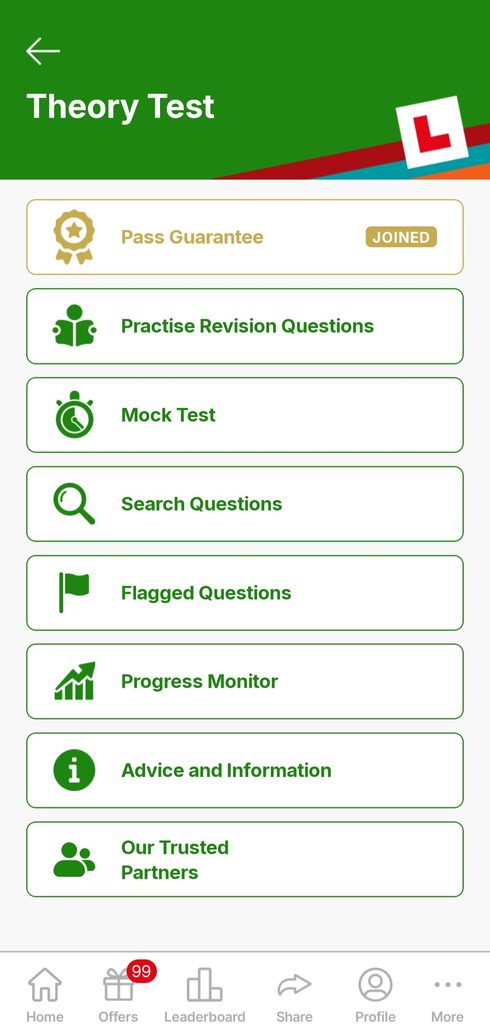
    So, you can see there has so many areas that help you to understand the question and if you don’t understand then what you can do later .

    From the first ,Practise Revision Question . If you enter here you will get all categories question including video question . I’m giving you screen shot then you will understand.
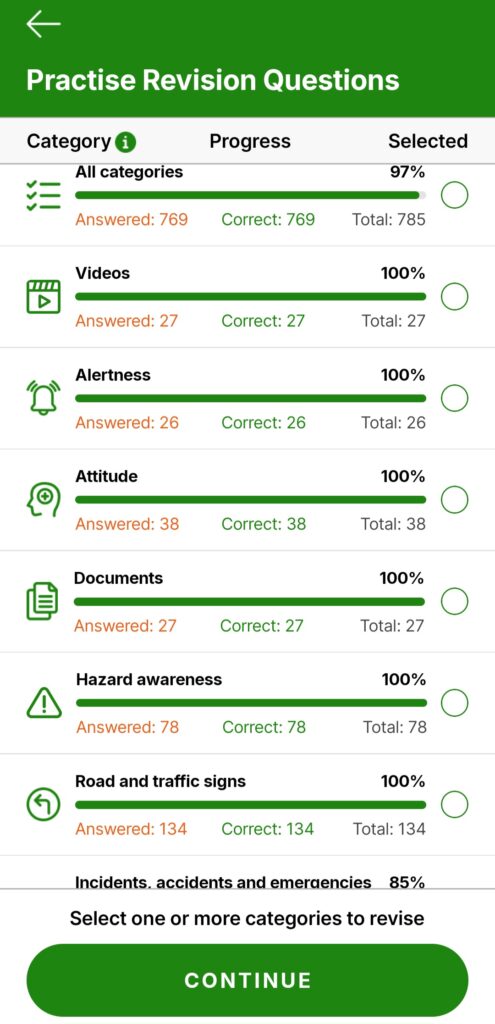
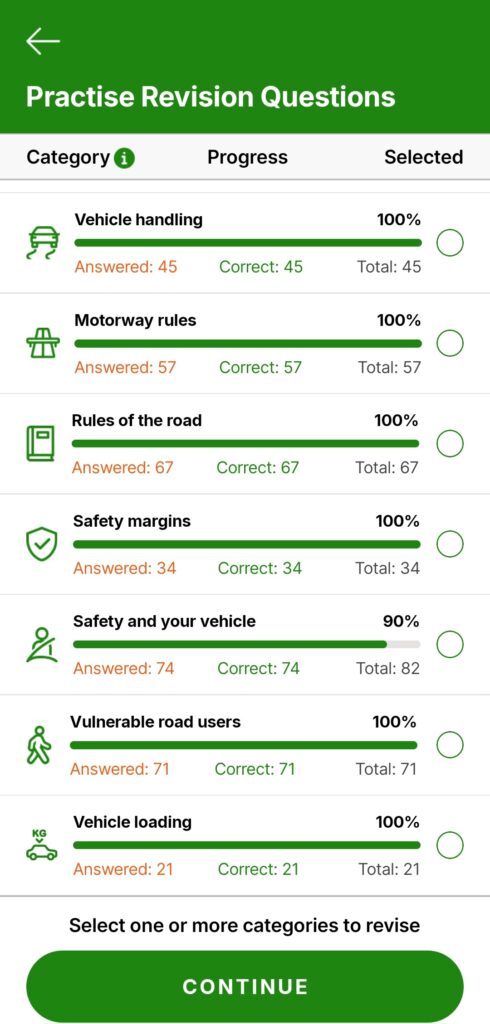
    So, you can see there are 15 categories question which is Videos, Alertness, Attitude, Documents, Hazard awareness , Road and traffic signs, Incidents accidents and emergencies, Other type of vehicle , Vehicle handling , Motorway rules, Rules of the road, Safety margins , Safety and your vehicle, Vulnerable road users, and Vehicle loading . There are 785 questions for practise .

    You can flag your question that you don’t understand or when you want to revise more . You can see the progress monitor that how your journey is going . When you almost complete all categories you can do Mock test.

    2 . Hazard Perception Practice

    Hazard perception is another important part of the theory test. People say hazard perception is rather than theory questions. Yes it is easy if you understand the concept and if you are attentive .

    You’ll watch videos clips and need to identify developing hazards by responding at the appropriate time . Practising this section is important because knowing the Highway code alone doesn’t automatically means you’ll be good at spotting developing hazards.
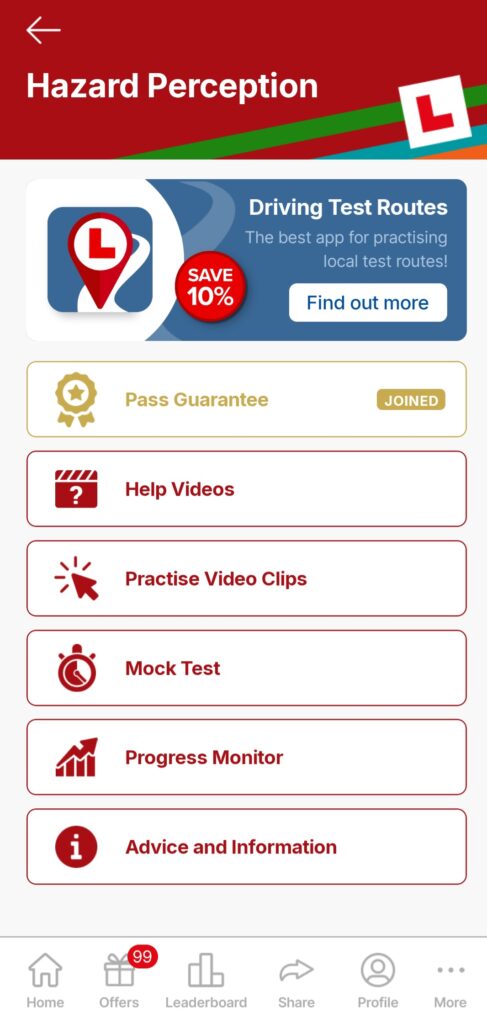
    In Hazards perception there has Introduction Video , Practise Video clips, Mock test , Progress monitor. First you can watch the introduction video then you can enter practise video clips. In this part there are two type , one is DVSA CGI clips and another Real life clips. Each part has four categories video which are Rural , Suburban , Urban, and Motorway . If you practice regularly you can easily understand the concept and you will get your best result. Remember , “Practice makes a man perfect” .
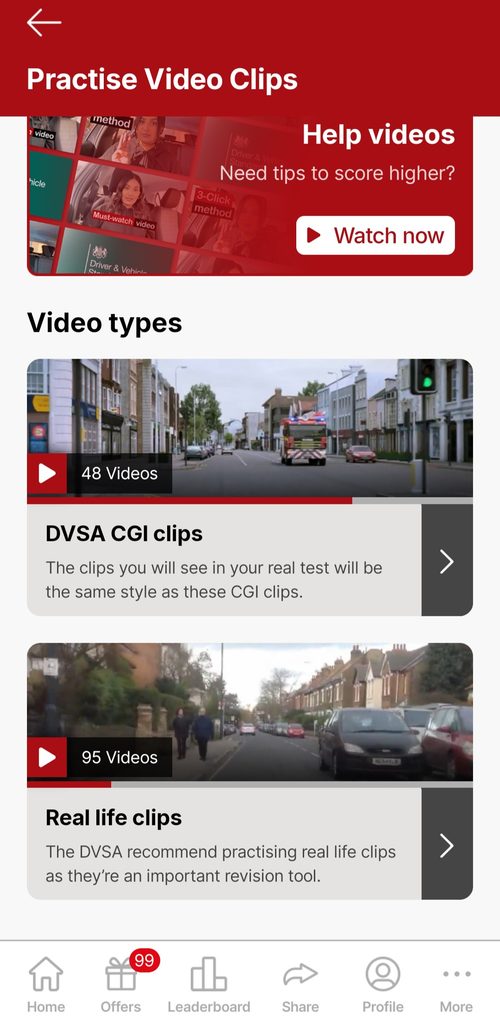
    When you understand all the videos and practice each then you can participate in Mock test. For the hazard perception there is a option that you can see what is your progress .

    3 . The Highway Code

    The Highway Code is one of the most important resources for anyone learning to drive in Great Britain .

    When you enter the High Code you will see there are so many categories among them Road works, Level Crossing, Tramway, Using the road, Control of the vehicle , light signals controlling traffic , information sign, road marking etc important .
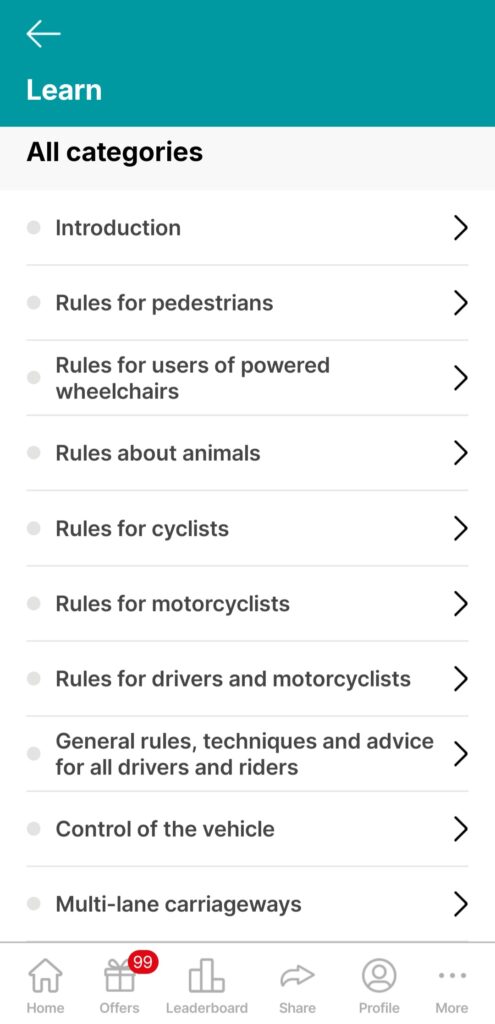
    When you will read every categories and fully understand you participate in Quiz which helps you to set the concept in your mind which is very important . If everything set in your mind you can just revise .

    4 . Mock Theory Tests

    Mock tests are where you can see whether your revision is actually working .

    I want to tell you something that before the practice don’t just give the mock test . When you practice all the categories touch the all categories then you should focus on the mock test.
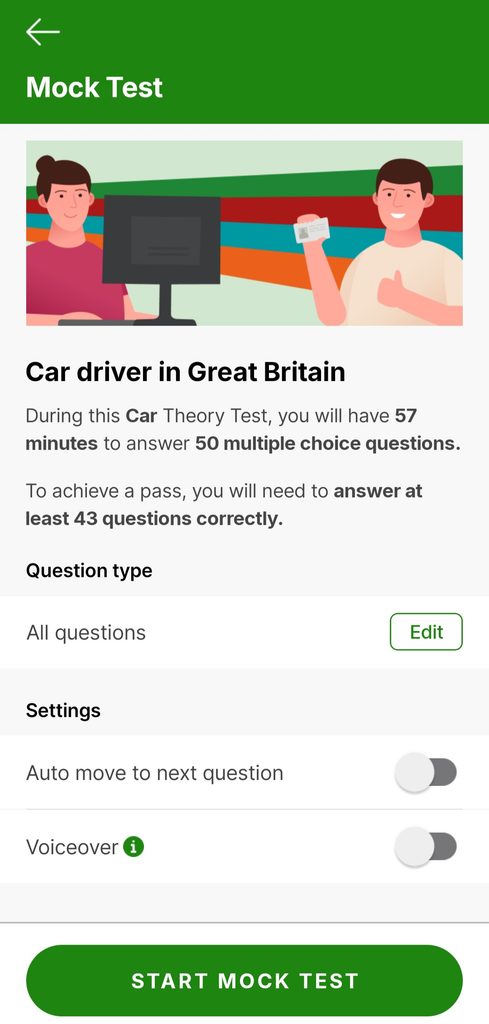
    Instead of taking one mock test and stopping , use your results to identify weak areas.

    For example , If you repeatedly make mistakes with :

    • Road and traffic signs
    • Motorway rules
    • Vulnerable road users
    • Rules of the road
    • Documents

    You should leave the mock and focus on the study those categories before taking another mock test. This kind process will helps you get the better result which is you are expecting for . When you do it again and again once you’ll see that you pass the mock test . And passing the mock test its great achievement. If you pass the mock regularly that’s mean you’re ready for the real theory test .

    5. Road Signs

    We all are know that how signs are important for the driving . Sign is the key of good and smooth driving also for safety . Without follow the signs you’ll fall to the danger .

    The Theory 4-in-1 app offers a dedicated road signs feature to help you learn each sign and understand its meaning. On road signs part there are 7 categories such as , Directional. Information, Orders, Markings, Road works , Signals, Warnings.
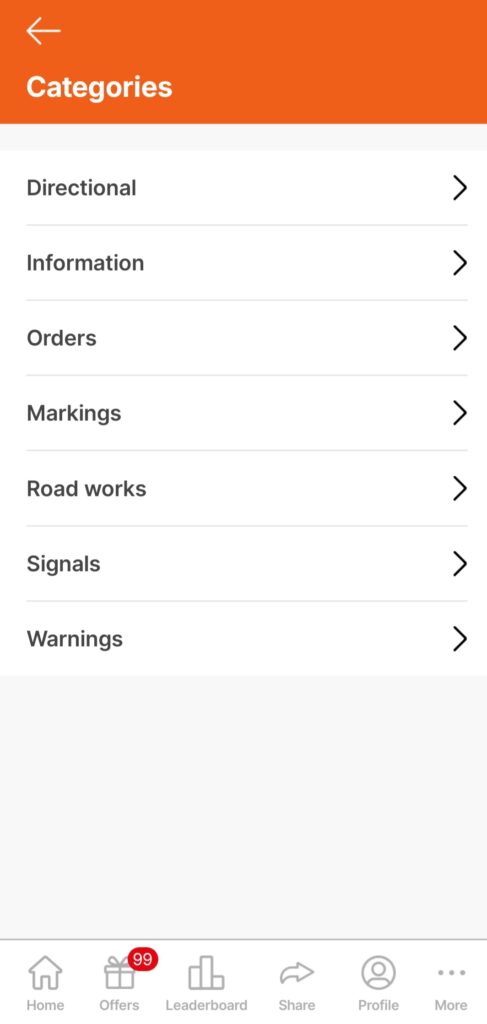
    I’m just elaborate about those categories below :

    • Directional signs: These help you to find your way and tell you where a road or destination leads . Examples , directions to town and cities, motorway , junctions , lane destinations, Routes to places such as airports or hospitals etc.
    • Information Signs: These provides useful information about the road or nearby facilities. Examples; parking areas , Bus stops, One-way roads, Tourist information, Emergency facilities, Services available, ahead etc.
    • Orders: This sign is very important for every driver because every moment need to see this sign and maintain otherwise you’ll get penalty for it . Examples ; No entry, No right turn , No left turn, No U-turn , Turn left/right, Keep left/right , Speed-limit signs etc.
    • Markings : These are signs or lines painted on the road surface. Examples; White centre lines, Give way markings , Stop lines , Yellow lines , Box junctions , Lane arrows , Pedestrian crossing markings etc.
    • Road Works : These signs warn you about temporary changes or hazards caused by road construction or maintenance . Examples ; Road works ahead, Temporary speed limits, Lane closures, Temporary traffic lights, Diversions, Uneven road surfaces etc. You may see temporary signs with yellow backgrounds.
    • Signals : These are signs and signals that control traffic movement . Examples; Traffic lights, Red /amber/green signals , Pedestrian crossing signals, Lane-control signals, Signals used at level crossings.
    • Warnings: Warnings signs alert you to a potential danger or hazard ahead. Examples; Sharp bend, Roundabout , Traffic signals ahead, Pedestrians, Children , Slippery road, Animals crossing , Road narrows , Steep hill etc.

    Why choose a Theory 4-in-1 app?

    The biggest advantage is convenience. In this app you’ll get everything together like questions , hazards perception , high codes . So, don’t buy one app for questions, another for hazards perception . Also, this app has opportunity when you revised it automatically save and that’s why you revise while travelling , during break time or at home .

    Does it offer realistic mock tests?

    One things is yes, it will help you to feel the real test vibe but doesn’t mean that same questions with same questions pattern you will get in the real test exam . On the real test question they use synonym antonym words and phrase the sentence while meaning is same . So , yes if you do mock test regularly and pass every test you can do better on the real test.

    Free or Paid ?

    This is the main things for apps user because everyone search for is it paid or free . There are several apps available on the google play store which are free but the question is do want to pass the test or just for understand .

    I know everyone are here for pass the theory test and looking for the best theory apps 2026 so for pass the test I think you should choose paid app like Theory 4-in-1 . Fact is if you install the free apps you can’t get your all the questions and it will be ready hard for you to pass the test . And paid apps will give you all the access that will help you to understand the question and process.

    So, This apps fee is £5.99 when you purchase Theory 4-in-1 app you’ll get all the access.

    Final thoughts:

    The best theory apps 2026 aren’t necessarily the ones with the biggest number of features . The most useful app is one that gives you accurate , up-to-date revision material and makes it easy to practice consistently.

    For many learners, a 4-in-1n theory app is an attractive option because it combines theory questions , hazards perception , Highway code information and mock tests in one place.

    Before your test , make sure you’re not just memorizing answer. You should understand the question and think what is the answer.

    At last, Keep practicing don’t waste your time of thinking about apps like which one is good or bad just buy it and start your journey once a day you’ll see you’re the master of theory . Good Luck .

    Do know how many manoeuvres in practical test? Click here

    Download the Theory 4-in-1 app? Click here

    Book your Theory test ? Click here
  • How Many Manoeuvres in Driving Test UK

    How Many Manoeuvres in Driving Test UK

    If you are preparing for your UK practical driving test, you have probably heard your instructor talking about different driving manoeuvres. Many learners wonder how many manoeuvres they actually need to know and, more importantly, which one they will be asked to do on test day.

    Great news is that you do not have to perform every manoeuvre during your practical driving test.

    In the current UK car driving test, the examiner will ask you to complete one of three possible reversing manoeuvres. The manoeuvre is selected by the examiner, so it is important to practise all three rather than relying on just one.

    How many manoeuvres in driving test UK?

    There are 3 possible reversing manoeuvres that can be tested:

    1. Parallel parking
    2. Parking in a bay
    3. Pulling up on the right and reversing

    You will normally be asked to perform one of these during your practical test. The Driver and Vehicle Standards Agency (DVSA) uses these exercises to assess your vehicle control, observation and ability to carry out a manoeuvre safely.

    Let’s look at each one.

    1. Parallel parking

    Parallel parking is one of the manoeuvres many learners practise regularly with their driving instructor.

    During the test, the examiner may ask you to pull up before a parked vehicle, drive alongside it and then reverse into a suitable parking position. You should finish reasonably close and parallel to the kerb.

    The examiner is looking at more than simply whether you can get the car into the space. Your observations, control and safety are also important.

    For example, you should be checking around the vehicle while reversing and be prepared to stop if another road user or hazard appears.

    The official examiner guidance says that the exercise should generally be completed within about two car lengths.

    2. Parking in a bay

    The second possible manoeuvre involves a parking bay. It is the easiest manoeuvre if you compared others .

    You may be asked to:

    • Reverse into a parking bay and then drive out, or
    • Drive forward into a parking bay and then reverse out.

    The examiner will tell you which method to use.

    You can normally choose a suitable bay, depending on the layout of the test centre or car park. The important thing is to remain in control of the car, make effective observations and finish the exercise safely.

    When reversing into a bay, don’t become so focused on the parking lines that you forget to look around you. Good observation is a major part of the assessment.

    3. Pull up on the right and reverse

    This manoeuvre can seem unusual to learners because you have to move across to the opposite side of the road.

    The examiner will ask you to pull up on the right when it is safe to do so. Once stopped, you will be asked to reverse for approximately two car lengths, keeping reasonably close to the kerb.

    After completing the reverse, you will be asked to drive on when ready.

    This exercise tests your ability to judge oncoming traffic, make effective all-round observations and maintain good control while reversing.

    Do you have to do all 3 manoeuvres?

    No.

    This is one of the most common misunderstandings among learner drivers.

    You only have to perform one of the 3 possible reversing exercises during your car driving test. However, it is still important to practise all three because you will not normally know in advance which one the examiner will choose.

    What happened to the turn in the road and reversing around a corner?

    If you have heard older drivers talking about the “three-point turn” or “reverse around a corner”, you may wonder why they are not included in the list.

    These manoeuvres were removed from the standard car driving test when the test was changed in December 2017.

    The current test instead uses manoeuvres that are intended to reflect situations drivers may encounter in everyday driving, including parking and pulling up on the right.

    You may still be taught these older manoeuvres by your driving instructor because they can help you develop useful car-control and observation skills.

    Can you fail your driving test because of a manoeuvre?

    Making a small mistake during a manoeuvre does not automatically mean you will fail your driving test.

    For example, you may need to make an adjustment while parking. What matters is how safely and appropriately you deal with the situation.

    However, you can receive driving faults, and a serious or dangerous fault can affect your test result. Your examiner will assess your control, observations and how you respond to other road users and hazards.

    The DVSA specifically highlights effective all-round observation as an important part of manoeuvring.

    How should you practise those essential manoeuvres?

    The best approach is not simply to memorise a fixed steering routine.

    Every road, parking bay and situation can be slightly different. Instead, learn how to:

    • Control the clutch, accelerator and brake smoothly.
    • Check your mirrors regularly.
    • Make effective all-round observations.
    • Look for pedestrians, cyclists and other vehicles.
    • Keep the car at a safe speed while reversing.
    • Make adjustments when necessary.
    • Stop if the situation becomes unsafe.

    Practise each manoeuvre in different locations and conditions. This will help you become more confident and less dependent on memorising exact reference points.

    Final thoughts

    So, how many manoeuvres are in the UK driving test?

    There are three possible reversing manoeuvres, but you will normally be asked to complete only one during your practical car driving test:

    • Parallel parking
    • Parking in a bay
    • Pulling up on the right and reversing for around two car lengths

    The examiner chooses which manoeuvre you will do, so practising all three is the safest way to prepare. If you practise those essential manoeuvres regularly no one can stop you to get the most valuable things for your life . Keep motivate yourself you’ll be the master of the driving. Many learner driving students don’t know how many manoeuvres in driving test UK for those you should write down in your notebook and keep practising on the road.

    Remember that the driving test is not just about parking the car perfectly. Your examiner is also watching how you observe, control the vehicle and respond to other road users. If you focus on being safe and in control rather than simply trying to remember a parking formula, you will be much better prepared for test day.

    If you want to book your theory test . Click here .

    If you want to book your practical driving test . Click here

  • Easiest bank account to open online UK

    Easiest bank account to open online UK

    Easiest bank account to open online UK

    Moving to the UK can involve a lot of paperwork, and opening a bank account is often one of the first things newcomers want to arrange.

    A UK bank account can make everyday life much easier. You can receive your salary, pay bills, set up direct debits and manage your money without relying on cash.

    The good news is that opening a bank account in the UK is usually straightforward, although the requirements can vary depending on the bank and your personal circumstances.

    In this guide, we’ll explain how the process works, what documents you may need and what you can do if you don’t yet have proof of address.

    Can a newcomer open a UK bank account?

    Yes. Many people who move to the UK can apply for a UK bank account.

    However, banks normally need to verify your identity and, depending on the account and bank, may also ask for information about your UK address, immigration status or circumstances.

    The exact requirements aren’t the same for every bank, so it’s worth checking the bank’s current requirements before starting an application.

    What documents might you need?

    The documents requested can vary, but you may be asked for some of the following:

    A valid passport or other accepted identity document

    Proof of your UK address

    Your immigration or residence documentation, where applicable

    A UK mobile phone number

    Information about your employment or income

    You don’t necessarily need every document listed above. The bank will tell you what it requires during the application process.

    What can be used as proof of address?

    This is one of the most common difficulties for people who have recently arrived in the UK.

    Depending on the bank, acceptable documents may include things such as:

    A tenancy agreement

    A council tax document

    A utility bill

    An official government letter

    A bank statement showing your address

    Important: Don’t assume that one particular document will always be accepted. Requirements can differ between banks and can change over time.

    Can you open an account without proof of address?

    Sometimes, but it depends on the bank and the type of account you’re applying for.

    Some banks may offer accounts designed for people who have recently arrived in the UK, while others may have stricter address-verification requirements.

    If you’re struggling to provide proof of address, check the bank’s current requirements or contact the bank before submitting an application.

    How to apply for a UK bank account

    The process is generally simple.

    1. Choose a bank

    Compare several banks rather than choosing the first one you see.

    Consider:

    Monthly fees

    Online and mobile banking

    ATM availability

    International transfers

    Customer service

    Whether the bank accepts newcomers

    2. Check the eligibility requirements

    Before applying, check exactly what documents the bank requires.

    This can save you time and reduce the chance of your application being delayed.

    3. Complete the application

    Depending on the bank, you may be able to apply through:

    The bank’s website

    A mobile app

    A branch

    You may need to provide personal information such as your name, date of birth, address and employment details.

    4. Complete identity checks

    The bank may ask you to verify your identity using documents or an electronic identity-checking process.

    Answer the questions accurately and make sure the information you provide matches your documents.

    5. Wait for the bank’s decision

    If your application is successful, the bank will normally provide details about your new account and how to access online or mobile banking.

    Your debit card and PIN arrangements will depend on the bank.

    What if your application is rejected?

    Don’t panic.

    A bank declining an application doesn’t necessarily mean that you cannot have a UK bank account.

    There can be different reasons for an unsuccessful application, including difficulties verifying your identity or address.

    If this happens, contact the bank to find out whether they can explain what information is missing. You can also check the eligibility requirements of another bank.

    Avoid submitting multiple applications without understanding why the first one was unsuccessful.

    Can newcomers use online banks?

    Yes, digital and app-based banking can be an option for some newcomers.

    However, you should still check the provider’s eligibility requirements before applying. Some providers may have specific requirements relating to residency, identification or address.

    Don’t choose a bank simply because the application appears easier. Look at the account’s features, fees and terms as well.

    Final thoughts

    Opening a UK bank account is an important step for many people starting a new life in the UK. In recent years, many international students wants to find the easiest bank account to open online UK.

    The key is to prepare your documents, check the bank’s current requirements and make sure the information in your application is accurate.

    If you don’t have traditional proof of address yet, don’t assume that opening an account is impossible. Different banks have different requirements, so researching your options can make the process much easier.

    If you’re looking for best ai tool click here